


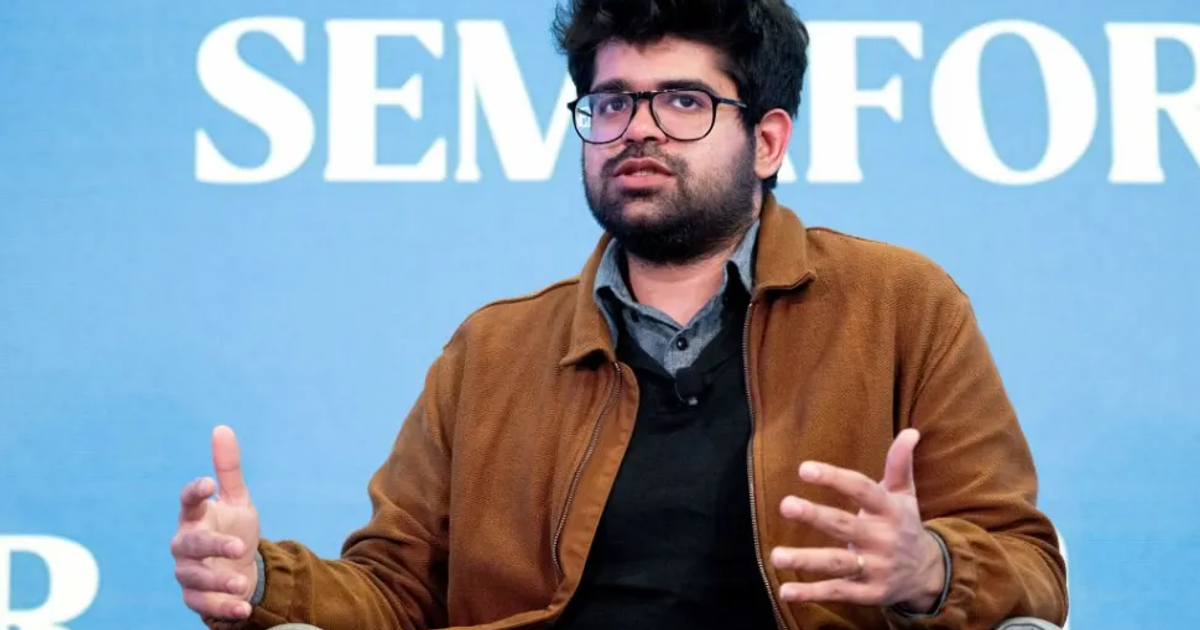
When CEO Aravind Srinivas launched Perplexity’s Comet web browser last month, he knew it wouldn’t live up to his vision of an operating system for the AI era, handling monotonous, time-sucking online tasks without any human help.
The AI models that power Comet weren’t good enough yet for that job and compute costs were astronomical. But that meant it was the perfect time to launch it, Srinivas said, reflecting go-to-market strategies in the latest tech boom.
“You’ve got to position your product and your technology with the assumption that the models are eventually going to be great and also going to be affordable,” says Srinivas, who founded his AI-powered online search startup in 2022.
Comet is different from other web browsers because of its right-hand column, where users can instruct an AI model to complete tasks, like going through LinkedIn profiles to find job candidates, filling out summer camp signup forms, or watching a YouTube video and summarizing it in bullet points.
But Comet, which comes with a $200 monthly Perplexity Max subscription, is still too limited to fulfill the goal of becoming like an operating system. It struggles with more complex, multi-step functions that require a lot of memory. And the vast majority of websites have not implemented AI functionality, making it difficult and resource-intensive for AI models to navigate.
On the tasks it can do, it delights its early adopters, who use it to send emails, add calendar entries, and place online orders, to cite a few uses. On X, Comet users post ideas for new ways to use the browser.
Srinivas says users are increasingly opting to make it their default browser and the waitlist has grown to more than one million. “The amount of people who are interested in trying and living, with all the imperfections, is pretty high,” he says.
Perplexity’s pace of innovation embodies the unique characteristics of product development in the era of generative AI, where instead of trying to perfect something, companies must anticipate what will be possible when yet-to-be-built AI models reach the market. That means walking a tightrope between launching a product that is too early and doesn’t work at all, or one that works perfectly but has already lost to fast-moving startups who got there first.
“It changes the way you think about building products,” said OpenAI Chief Product Officer Kevin Weil on a recent podcast with investors Bill Gurley and Brad Gerstner. “If you think about it right, it makes you much more open to building products that only kind of work. Because if the model can only kind of do it, then it’s going to be great in a few months.”
link