The quantum leap transforming how we compute

The modern smartphone is exponentially more powerful than the guidance computer used during the Apollo moon landings—proof of how quickly technology can reshape our world. For decades, Moore’s Law has held true, with computing power doubling roughly every two years as transistors shrink and costs fall. Yet as the miniaturization of computer components approaches their physical limits, the next wave of progress will depend on finding new ways to process information.
For Fujitsu, that pursuit builds on nearly a century of innovation—from early breakthroughs in telecommunications to Japan’s first computers. This heritage has naturally evolved into a new frontier: quantum computers, viewed as a powerful complement to artificial intelligence and a step toward a more sustainable, data-driven world.
Founded in 1935, Fujitsu has grown into a global technology firm with 113,000 employees, operating across computing, networks, AI, data and security, and converging technologies. Over the decades, the company has consistently demonstrated a commitment to innovation and advancing technology that benefits society.
Fujitsu’s early achievements—from automatic switching systems to radio equipment and submarine cables—laid the foundation for its evolution into a computing pioneer. In 1954, the company launched the FACOM100, Japan’s first domestically produced relay computer, marking a major milestone in the nation’s technological development.

Fujitsu has also been at the forefront of supercomputing. In 2011, it developed the K computer, which became the world’s fastest at the time. Following its decommissioning in 2019, Fujitsu continued to push boundaries with the unveiling of Fugaku, which once again earned the title of the world’s fastest supercomputer in 2021.
“Computing technology really changed the world for the last 50 years,” says Dr. Shintaro Sato, Head of Quantum Laboratory at Fujitsu. “Our goal at Fujitsu is to develop new technologies that improve computing performance in ways that will make life better and benefit society.”
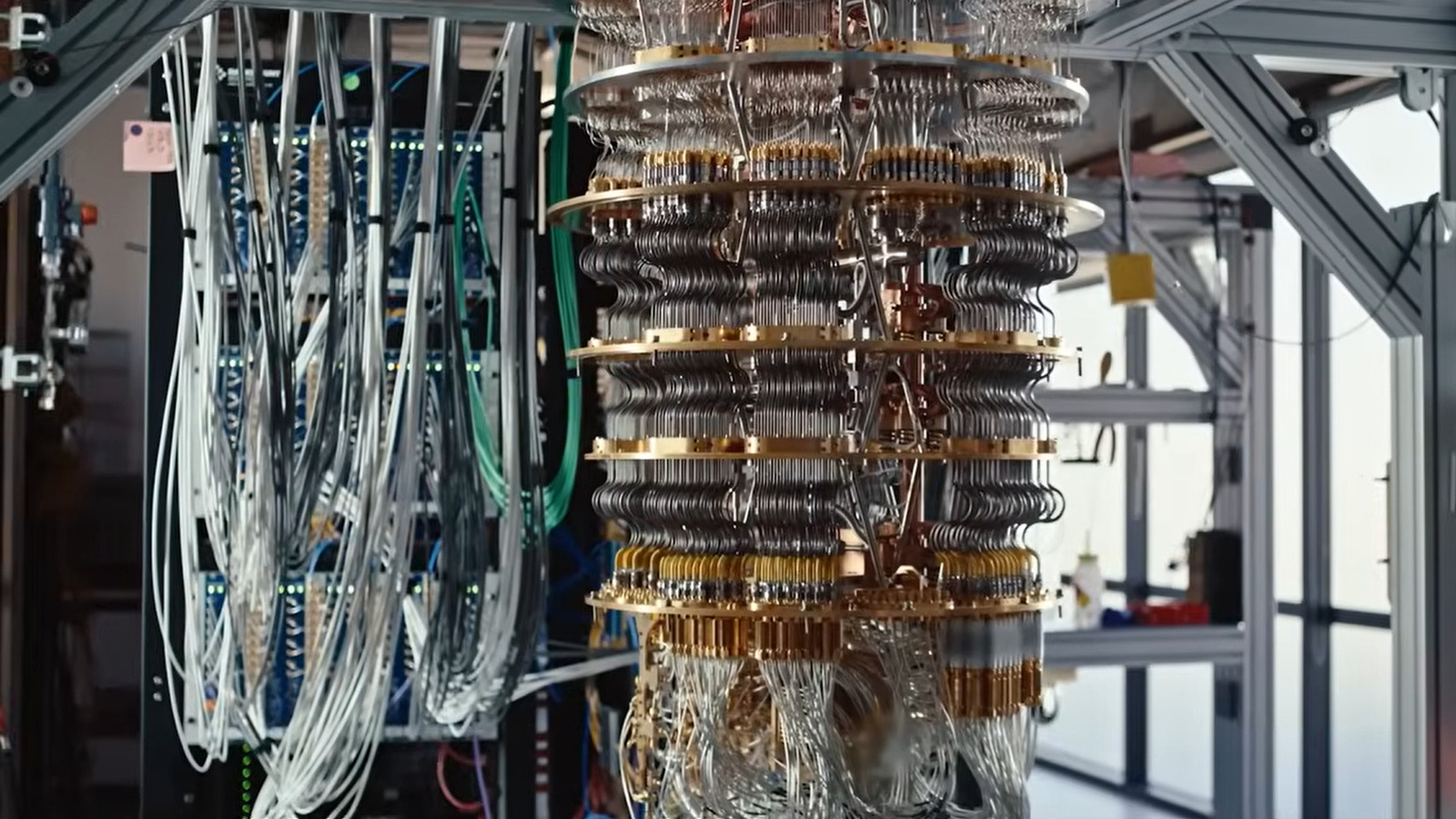
Yet even the most powerful supercomputers remain bound by the physical limits of classical architecture, prompting entirely new ways to handle information and ushering in the era of quantum computers. While conventional computers store information as bits that are either 1 or 0, quantum computers use qubits, which can exist as both 1 and 0 simultaneously through a phenomenon known as superposition. When qubits are linked, their combined capacity scales exponentially, giving quantum computers the potential to solve complex problems that would take classical computers far longer, with possible applications across materials science, healthcare, and finance.
Despite this promise, quantum computers face significant challenges. Qubits are fragile, difficult to control, and easily disrupted by heat or environmental noise, making large-scale, reliable systems hard to build. Quantum computers are also very error-prone, and researchers estimate that a minimum of one million qubits is required for a fault-tolerant quantum computer using quantum error-correction technology. In 2024, Fujitsu, in partnership with Osaka University, announced that a specific calculation—one that would take a classical computer five years—could theoretically be completed in just 10 hours using only 60,000 qubits.

“We are now improving that architecture so that we can do a practical quantum computation by using even less qubits,” says Dr. Sato, adding that improvement on multiple fronts, including the quality of the physical qubit, as well as hardware and software technology, will be required to realize this goal. Continuing its pursuit to advance practical quantum computing, Fujitsu announced in August 2025 the start of development of a 10,000-plus qubit superconducting quantum computer, operating with 250 logical qubits, targeting completion in 2030.
Quantum computing is not something consumers interact with directly, so its progress often goes unnoticed. Yet, behind the scenes, it is already shaping change. From accelerating drug discovery and optimizing traffic systems to enhancing climate modeling and energy efficiency, the technology points toward a future where smarter, more sustainable solutions can address pressing global challenges.
Fujitsu positions quantum computing as more than a technical pursuit—it views the field as a tool for purpose and social value. The company believes quantum computing can enable better decision-making, from developing eco-friendly materials to reducing waste, combating climate change, and improving quality of life worldwide. By framing quantum computers not merely as a computing milestone but as a means to advance sustainability, Fujitsu emphasizes its commitment to driving meaningful innovation.

To help bring quantum computing to maturity, Fujitsu collaborates with leading research institutions such as RIKEN, Delft University of Technology, and Osaka University. These collaboration efforts will eventually allow the exploration of problems beyond the reach of conventional supercomputers, such as the characterization of novel catalyst materials used to accelerate chemical reactions, opening pathways to new discoveries.
To support this ecosystem, Fujitsu is working with partners to apply quantum research in co-developing practical applications tailored to their industries, and leveraging a hybrid framework that integrates quantum computers with other computing technologies.
To accelerate process of finding effective catalysts, for example, different computing technologies are combined to simulate the outcomes of various catalyst types. AI is then used to analyze the data and identify even better candidates. “AI is a key technology, now and in the future,” says Dr. Sato, adding that one of the goals for quantum computing is to eventually realize better AI while reducing its power consumption. “AI and quantum computers are closely related to each other, and they should work together for a better future.”

Fujitsu continues to advance quantum research with a focus on real-world impact and responsible innovation, ensuring the technology serves society as it evolves. With early breakthroughs expected in industries such as automotive, chemicals, financial services, and life sciences—potentially generating up to $1.3 trillion in value by 2035—quantum computers are poised to transform both technology and society, and Fujitsu is helping shape that future responsibly.
Learn more about Fujitsu’s work with quantum computing here.
link